VA Loan Underwriting and Lender Overlays
A VA loan is guaranteed by the Department of Veterans Affairs (VA), but a private lender makes it. That split is why two lenders can look at the same borrower and give different answers.
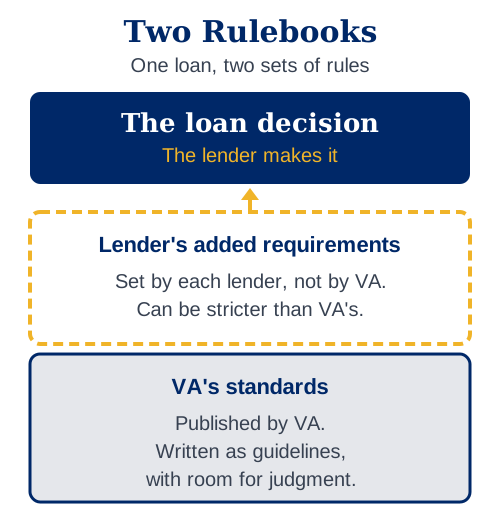
Two rulebooks apply to every VA loan. VA writes and publishes the first, and it leaves room for judgment. The lender sets the second, and it can be stricter. Underwriting is the review where a lender checks your credit, income, debts, and assets against those rules and decides whether to approve the loan.
Once you can tell which rule belongs to VA and which belongs to a lender, "why did Lender A say yes and Lender B say no" stops being a mystery. You also know what to ask and what to do next. This guide is written for veterans and for the real estate agents working with them.
What Underwriting Means on a VA Loan
By law, VA may guarantee a loan only when the veteran is a satisfactory credit risk and has income that fits the loan's payment terms. The lender applies that test, and the lender is responsible for it. VA's regulation says lenders are "fully responsible for developing all credit information," and each lender must certify that the loan meets VA's requirements.
A lender with automatic authority can close a VA-guaranteed loan without VA's prior approval, so its own underwriting decision is the one that counts.
A lender may also run your file through an automated underwriting system, software VA has approved for VA loans. The system returns a finding such as "Approve or Accept" or "Refer." VA says these systems "do not approve or disapprove loans" and only sort a file by risk. A VA-approved underwriter still makes the decision.
What VA Itself Checks
VA's underwriting standards are "guidelines for underwriters," and VA expects underwriters to use "good judgment and flexibility." The standards are in federal regulation, and the main tests fit in a table.
| VA test | What VA's rules say |
|---|---|
| Debt-to-income (DTI) ratio | Monthly housing costs plus long-term debts, divided by gross monthly income. VA's standard is 41% or less. Above 41%, a lender can still approve the loan with documented offsetting factors and a supervisor's review, or without that extra review if residual income beats VA's guideline by at least 20%. It is not an automatic cutoff. |
| Residual income | The money left from your net income each month, after debts and housing costs, to pay for family living expenses. VA's guideline amounts vary by region, family size, and loan amount. It is a guide read with the rest of the file, not an automatic pass or fail. |
| Credit history | VA has no minimum credit score. Underwriters look at overall payment patterns, not isolated slips. Credit is generally considered re-established after 12 months of satisfactory payments following the last derogatory item. Medical collections may be disregarded. A bankruptcy does not disqualify a loan by itself. A Chapter 7 bankruptcy or a foreclosure more than 2 years before closing may be disregarded, and a more recent one faces a closer test: VA looks at what caused it and how you have handled credit since. Chapter 13 has its own rules. |
| Stable income | VA looks for 2 years of work history, not necessarily with one employer. Prior jobs, school, or training can fill a shorter stay at the current job, and gaps get explained. Overtime, part-time work, second jobs, and bonuses generally need 2 years of verified history. VA disability income does not need to be documented as likely to continue. |
| Assets | You need cash for closing costs and prepaid items you do not finance. VA does not require reserves (cash left after closing to pay a set number of mortgage payments) on the home you will live in, though it weighs your liquid assets in the overall review. |
To see how your income and debts shape a monthly budget, try the Home Affordability Calculator.
What a Lender Overlay Is
A lender overlay is a requirement a lender adds on top of VA's standards. VA does not require it. The lender chooses it, sometimes because an investor that buys the loan asks for it.
VA says as much on VA.gov: lenders follow VA's standards and "may also require you to meet additional standards" before lending. VA names two examples, a high enough credit score and an updated home appraisal.
VA also uses the word "overlay" in its own circulars, which are official notices to lenders. Circular 26-23-17, written for a federal government shutdown, says a requirement for IRS Form 4506-T (a form that requests your tax return transcripts from the IRS) would be "an investor or lender overlay exceeding the guidelines established by VA." It tells lenders to follow VA's income-verification guidelines. For assumptions, where a buyer takes over a seller's existing VA loan, VA treats one situation as a compliance problem. Circular 26-23-27 lists denying a buyer because of a holder overlay as a failure to follow VA's rules. That rule is about assumptions only, and the assumptions guide shows how it works.
Why One Lender Says Yes and Another Says No
Several points in VA's own materials help explain the difference.
- VA's standards leave room for judgment. VA calls its list of offsetting factors "not exhaustive," and it lets a lender treat less than 12 months on a job as stable when the documents support that. Two underwriters can land in different places on a marginal file.
- VA guarantees only a portion of the loan. If a loan ends in foreclosure, VA reimburses the lender for "all or part" of the loss, limited by the guaranty. For a borrower with full entitlement on a loan above $144,000, the guaranty is up to 25% of the loan amount. VA pays up to a set share, so the lender carries the rest of the risk.
- Lenders answer for VA's rules. VA "may deny or reduce payment on a future claim" when a lender did not comply with its rules. VA does not say this is why lenders add requirements, but it gives every lender a reason for caution.
- Investors set terms. A lender that sells its VA loans to investors must keep loan sizes within the maximums those buyers set, and VA's circular names investors as one source of overlays.
- Automated systems have their own terms. VA approved the systems but is not their vendor, so each lender negotiates its terms of use directly with the provider.
The table below pairs VA's rule with examples of what a lender may add. These are examples, not a survey of what any particular lender requires.
| Topic | VA's rule | A lender may add |
|---|---|---|
| Credit score | VA has no minimum credit score | A minimum score (VA says some lenders have one) |
| Appraisal | A VA appraiser checks the home against VA's minimum property requirements | An updated appraisal (VA.gov names this as an example) |
| Income documents | Lenders follow VA's income-verification guidelines | A requirement for IRS Form 4506-T, which VA's Circular 26-23-17 calls an overlay |
| Loan size with no down payment | No VA loan limit for a borrower with full entitlement (the appraisal and the lender's guidelines still apply) | With remaining entitlement, a cap of four times remaining bonus entitlement, a lender practice and not a VA rule (see the COE guide) |
| Reserves | VA does not require them on the home you will live in | A reserves requirement (ask the lender) |
The VA Loan Limit Estimator is a place to start on how entitlement can affect loan size.
What You Can Do About It
- Ask each lender what it requires beyond VA's standards. Bring your documents and ask the loan officer to review them. For a preapproval, the Consumer Financial Protection Bureau (CFPB) suggests asking what assumptions the lender made and whether anything in your situation could lead to a denial later.
- Compare lenders. VA tells borrowers to contact more than one lender, and the CFPB advises contacting at least three, even when a real estate agent recommends one. Multiple mortgage credit checks within a 45-day window count as a single inquiry on your credit report. Agents can help by introducing a client to more than one lender with VA loan experience. A mortgage broker does not lend money and can help you find different lenders.
- If a lender declines you, ask for the reasons in writing. The lender must give you the specific reasons or tell you that you can ask for them within 60 days. If your credit report played a part, you may be entitled to a free copy from the credit reporting company if you ask within 60 days.
- Check your credit reports and fix errors. You can get free copies at annualcreditreport.com. If you find an error, dispute it with the credit reporting company, which must investigate and correct any errors it finds.
- Consider a HUD-approved housing counselor. The U.S. Department of Housing and Urban Development (HUD) approves counselors who can offer independent advice, often at little or no cost. The CFPB has a housing counselor finder.
- Call VA with questions about its rules. VA's home loan line, 877-827-3702, can answer questions about how VA's rules apply. Your lender, not VA, still has to approve you.
- Report a problem to the CFPB. If you have an issue with a lender or a loan, you can submit a mortgage complaint. A complaint is not an appeal of a lawful decline.
Another lender may reach a different answer on the same file. It may also reach the same one, and no step here guarantees an approval.
Where VA's Rules Live
VA's underwriting standards are in 38 CFR 36.4340, part of the Code of Federal Regulations. The VA Lenders Handbook (VA Pamphlet 26-7) is written for lenders, and its Chapter 4 is the credit underwriting chapter.
Talk Through a Specific File
Gene is a Mortgage Loan Originator (MLO) who can review a specific file with you and talk through which requirements come from VA and which come from a lender. A review is not a promise of approval, and no one can say in advance what a given lender will decide.
This article is general information, not a commitment to lend or financial advice for your specific situation. VA rules and lender requirements change, so confirm current requirements with a lender.
More questions? Read the VA loan Q&A or explore all guides.
Gene Richter, MLO, NMLS #2806488 | PBT Bancorp, NMLS #257781. General information, not a commitment to lend. Not affiliated with or endorsed by the U.S. Department of Veterans Affairs.