COE, Entitlement, and the VA Funding Fee: How the Three Fit Together
Three terms come up in almost every VA purchase: the Certificate of Eligibility, entitlement, and the funding fee. The Certificate of Eligibility (COE) is the paper. Entitlement is the number printed on it. The VA funding fee is a one-time cost that depends on what the COE says and on how much you put down.
This guide is written for the buyer and for the real estate agent working with them.
The Certificate of Eligibility (COE)
The COE is the document you show a lender to prove you qualify for the VA home loan benefit. Requesting one is the first step in getting a VA-backed loan. Two things on it matter here:
- Your entitlement. The COE shows your basic entitlement and, in a table called "Prior Loans charged to entitlement," any entitlement already tied to earlier VA loans.
- Your funding fee status. The COE shows whether you are exempt from the funding fee or not.
A COE is not a loan approval. You still need to meet credit, income, and occupancy requirements from VA and from your lender.
Who can get one
VA sets minimum service lengths that vary by era, with exceptions. In summary:
- Active-duty service members: at least 90 continuous days.
- Veterans who served since August 2, 1990: generally 24 continuous months, or the full period they were called or ordered to active duty (at least 90 days).
- National Guard and Reserve members: generally at least 90 days of active-duty service other than training, or six creditable years of service (with conditions on your status).
- Earlier eras and shorter service: each era has its own minimum. A veteran discharged for a service-connected disability, or under a qualifying exception such as hardship, may qualify with less time.
- Discharge type: an other than honorable, bad conduct, or dishonorable discharge may not be eligible, but you can apply and VA reviews your service records.
- Surviving spouses: you may be able to get a COE if you are receiving or eligible for certain types of VA Dependency and Indemnity Compensation (DIC), or you are the spouse of an active-duty service member who is missing in action or a prisoner of war.
VA's eligibility page has the full list by era.
How to request one
| Route | How it works | Good to know |
|---|---|---|
| Online | You request it on VA.gov | Do not submit a second request while the first is pending |
| Through a lender | The lender requests it through VA's online system for lenders | In many cases VA's system issues it right away |
| By mail | You send VA Form 26-1880, "Request for a Certificate of Eligibility," to your regional loan center (the address is on the form's last page) | VA says mail requests may take longer than the other two |
VA says most COEs are processed instantly, some take up to about five business days, and a few take longer if VA needs more information. If a lender cannot get one through the online system, that does not mean you are ineligible. The system may lack the information to decide automatically.
VA asks veterans for a copy of their discharge or separation papers (DD214). Active-duty, Guard, and Reserve members send other documents, and VA's how-to-request page lists them.
One exception: a COE is not required for an Interest Rate Reduction Refinance Loan (IRRRL). This guide focuses on buying a home.
Entitlement: The Number on Your COE
Entitlement is the size of VA's guaranty. A guaranty is VA's promise to your lender: if you stop repaying the loan, VA pays the lender up to a set amount. It protects the lender. It is not money you receive, and it is not the most you can borrow. In most cases, that protection is what allows a purchase with no down payment.
Entitlement comes in two tiers (as of 2026):
- Basic entitlement (first tier) is $36,000. On a loan of $144,000 or less, VA guarantees up to that amount. ($36,000 is 25% of $144,000.)
- Bonus entitlement (second tier) is the amount VA guarantees on a loan above $144,000.
Your COE puts you in one of two positions:
| Full entitlement | Remaining entitlement | |
|---|---|---|
| COE shows | Basic entitlement of $36,000 | An "Entitlement Charged" amount for a VA loan not yet restored |
| County loan limit | None on the guaranty since January 1, 2020 | Part of the calculation |
| Guaranty above $144,000 | Up to 25% of the loan amount | Up to 25% of the county loan limit, minus entitlement already used |
Full entitlement
If your COE shows basic entitlement of $36,000, you have full entitlement. Beginning January 1, 2020, VA no longer applies a county loan limit to the guaranty for a borrower with full entitlement. On a loan above $144,000, VA guarantees 25% of the loan amount.
That does not mean any loan size works. Your lender still reviews your credit, income, debts, and assets. The appraisal matters too: the loan is capped at the lower of the purchase price or the appraised value. In VA's example, a buyer preapproved for up to $450,000 signs a $400,000 contract, the home appraises at $375,000, and the loan is capped at $375,000.
Remaining entitlement
Some borrowers have used part of their entitlement and not gotten it back, for example because a VA loan on a home they kept is still open. You can still use what is left. Bonus entitlement is not listed on the COE, so you or your lender calculate it with VA's method: take the county loan limit, multiply it by 25%, and subtract the entitlement already used.
The county loan limit is the one-unit limit, even if the property has more units. VA uses the same limits as the Federal Housing Finance Agency (FHFA), which sets them every January. As of 2026 the baseline is $832,750, it applies in most of the United States, and high-cost counties are higher. FHFA has a county lookup.
In VA's own example, John already has a VA loan with $75,000 of entitlement charged, and he wants to buy a $500,000 home in a county with the 2026 limit of $832,750.
| Step | Amount | How it is found |
|---|---|---|
| Entitlement already used | $75,000 | "Entitlement Charged" on the COE |
| County loan limit | $832,750 | One-unit limit for the county, 2026 |
| 25% of the limit | $208,187.50 | $832,750 × 0.25 |
| Remaining bonus entitlement | $133,187.50 | $208,187.50 minus $75,000 |
| Most lenders' no-down-payment ceiling | $532,750 | Remaining bonus entitlement × 4 |
Most lenders multiply remaining bonus entitlement by four to estimate the largest loan they will make without a down payment. That is a lender practice, not a VA rule. Above that line, a lender may ask for a down payment. John's $500,000 purchase sits under $532,750, so in VA's example he needs no down payment, provided the home appraises at value, he intends to live there, and he meets his lender's underwriting requirements.
The VA Loan Limit Estimator is a good starting point for the broader picture.
Restoration: Getting Used Entitlement Back
You may be able to restore entitlement used on an earlier VA loan if you still meet the eligibility requirements and at least one of these is true:
- You sold the home and paid that loan in full.
- A qualified veteran buyer assumes your loan and substitutes their own entitlement for the same amount you used.
- You repaid the loan in full but kept the home (you can do this only once).
Restoration must be requested. It is not automatic. You can request a COE with restoration online, through your lender, or by mail with VA Form 26-1880. If none of these fits, you may still have remaining entitlement. The guide Can You Use Your VA Loan Benefit More Than Once? has more on restoration.
Two VA Loans at Once
In many cases you can keep your current home and use remaining entitlement, or entitlement VA has restored, to buy another home to live in, as long as you meet your lender's requirements.
Every VA loan must meet VA's occupancy rules. In most cases you certify that you intend to live in the home, and you cannot use a VA loan to buy a vacation home or investment property. Budget for more than one mortgage. The benefit-reuse guide has more detail.
The VA Funding Fee
The VA funding fee is a one-time payment on a VA-backed loan. VA says it helps offset the cost of the program to taxpayers, which is why VA does not require a down payment or monthly mortgage insurance. It is not mortgage insurance, and it is not free. You pay it to VA, and your lender collects it at closing and sends it in. The fee is a percentage of the loan amount, not the purchase price.
VA funding fee schedule, as of 2026, for loans closing on or after April 7, 2023. Reserve and Guard members pay the same rates as veterans and active-duty members.
| Loan type | Down payment | First use | After first use |
|---|---|---|---|
| Purchase or construction | Less than 5% | 2.15% | 3.3% |
| Purchase or construction | At least 5%, under 10% | 1.5% | 1.5% |
| Purchase or construction | 10% or more | 1.25% | 1.25% |
| Cash-out refinance | Not applicable | 2.15% | 3.3% |
| IRRRL | Not applicable | 0.5% | 0.5% |
- The down payment tiers are measured against the purchase price and are not rounded.
- The schedule is set by law and has been amended before, so confirm current rates on VA's funding fee page, which also lists other loan types.
Refinances have their own rules, explained in IRRRL vs. Cash-Out: The Two Ways to Refinance a VA Loan. To compare VA loans with Federal Housing Administration (FHA) and conventional loans side by side, see VA vs FHA vs Conventional.
First use and after first use
The "after first use" column applies if you have used the VA loan benefit before. On a purchase it changes the fee only when the down payment is under 5%. At 5% or more, first and later use pay the same rate.
Restoring entitlement does not reset "first use." A borrower who paid off an earlier VA loan and got the entitlement restored still pays the higher rate, unless exempt.
How the fee is paid
You can pay the fee in cash at closing or finance it. Financing adds the fee to your loan, so it increases the loan balance. On a purchase, the fee is the only cost VA lets you finance, and every other fee and charge is paid at closing. Sellers and builders can offer credits toward the buyer's closing costs. VA does not limit credits for closing costs, but it does limit seller concessions to 4% of the home's reasonable value, and concessions include credits for the funding fee.
Exemptions and refunds
You do not pay the fee if any of these is true:
- You are receiving VA compensation for a service-connected disability.
- You are eligible to receive VA compensation for a service-connected disability but are receiving retirement or active-duty pay instead.
- You are receiving DIC as the surviving spouse of a veteran.
- You are a service member who received a proposed or memorandum rating before the loan closing date saying you are eligible for compensation because of a pre-discharge claim.
- You are an active-duty member of the Armed Forces and, on or before your loan closing date, you provide evidence that you received a Purple Heart.
In the first two, VA's wording is receiving compensation, so check your COE for how VA shows your status.
If you are a veteran with a compensation claim pending, ask your loan officer about an updated COE before closing. VA may refund the fee if you are later awarded compensation retroactive to a date before your loan closed, but a refund cannot be guaranteed, so do not plan to close and request a refund later.
How the Three Fit Together in a Purchase
Read the steps left to right. The COE sets the entitlement and fee status you are working with, your down payment sets the fee tier, and closing is where the fee is paid or financed.
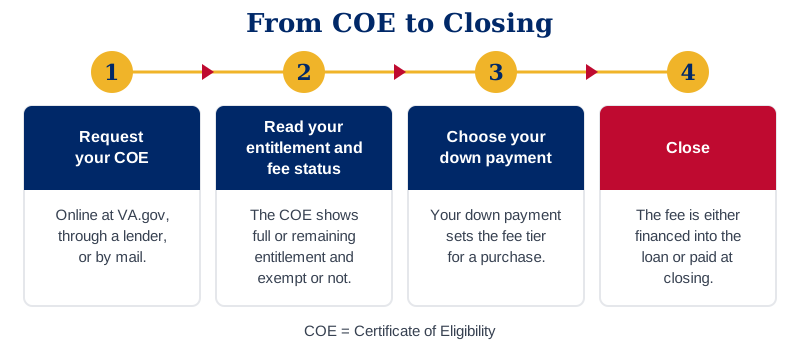
The next table is an illustration with round numbers. It is not a VA example; the figures apply the schedule above. Picture a first-time VA borrower who is not exempt, has full entitlement, and buys a $400,000 home that appraises at $400,000. Full entitlement means the limits are lender underwriting and the appraisal, not a county loan limit. The fee then depends on the down payment.
| Down payment | Loan amount | Fee, first use | Fee, after first use |
|---|---|---|---|
| None | $400,000 | $8,600 (2.15%) | $13,200 (3.3%) |
| 5% ($20,000) | $380,000 | $5,700 (1.5%) | $5,700 (1.5%) |
| 10% ($40,000) | $360,000 | $4,500 (1.25%) | $4,500 (1.25%) |
Financing the fee at no down payment raises the loan balance from $400,000 to $408,600. An exempt borrower pays $0. With no down payment, a repeat user pays $13,200 against $8,600 for a first-time user, and at 5% down the two pay the same.
Before You Write an Offer
For buyers and agents:
- Get a COE in hand. Ask the buyer's lender to pull it, or have the buyer request it, before the offer goes in.
- Read the entitlement line. Basic entitlement of $36,000 means full entitlement. Any amount under "Entitlement Charged" means the lender should calculate remaining entitlement with the 2026 limit for the home's county.
- Test the price. With remaining entitlement, ask whether the price is above the lender's no-down-payment ceiling. With full entitlement, remember the appraisal caps the loan at the lower of price or value.
- Check fee status. The COE shows exempt or non-exempt. If the buyer is a veteran with a compensation claim pending, ask about an updated COE before closing.
- Ask for the fee at each down payment tier. Have the loan officer show it with no down payment, 5% down, and 10% down, then decide whether to finance it or pay it at closing.
- Agents, ask about seller credits. A seller can offer credits toward the buyer's closing costs, and a credit for the funding fee counts toward VA's 4% limit on seller concessions.
- Start restoration early. A buyer who paid off an earlier VA loan and expects the entitlement back must request it.
Questions About Your Own COE
The right next step depends on what your COE shows. Gene Richter is a Mortgage Loan Originator who can review your COE with you, explain how your entitlement and funding fee status apply to a purchase you are considering, and answer questions along the way.
This article is general information, not a commitment to lend or financial advice for your specific situation.
More questions? Read the VA loan Q&A or explore all guides.
Gene Richter, MLO, NMLS #2806488 | PBT Bancorp, NMLS #257781. General information, not a commitment to lend. Not affiliated with or endorsed by the U.S. Department of Veterans Affairs.