IRRRL vs. Cash-Out: The Two Ways to Refinance a VA Loan
If you already have a VA-backed home loan, VA gives you two very different ways to refinance it: the Interest Rate Reduction Refinance Loan (IRRRL) and the cash-out refinance. They share the VA guaranty, but almost nothing else. Purpose, paperwork, underwriting, and the rules on fees and timing all differ. Confusing the two is the easiest way to end up disappointed by what a refinance can and can't do for you.
What Is an IRRRL?
An IRRRL is, in VA's own words, a VA-guaranteed loan made to refinance an existing VA-guaranteed loan, generally at a lower interest rate and with lower principal-and-interest payments than the loan it replaces. VA also calls it a "streamline" refinance. It's built for one job: lowering your rate, lowering your payment, or converting an adjustable-rate VA loan to a fixed rate so your payment stops moving.
To use an IRRRL, you need to:
- Already have a VA-backed home loan.
- Be using the IRRRL specifically to refinance that existing VA loan (not a different mortgage).
- Certify that you currently live in, or previously lived in, the home.
That last point is a real distinction VA draws on purpose. For an IRRRL, you certify prior occupancy, so even if you've since moved out, you may still qualify. Every other VA loan, including a cash-out refinance, requires you to certify current or intended occupancy as your primary residence.
What Is a Cash-Out Refinance?
A cash-out refinance replaces your existing mortgage (VA loan or not) with a new VA-guaranteed loan, and VA defines two distinct versions:
- Type I cash-out: the new loan amount (including the funding fee) does not exceed the payoff amount of the loan being refinanced. You're not pulling equity out; this version is often used simply to convert a non-VA loan (FHA or conventional) into a VA loan, or to refinance an existing VA loan without taking cash.
- Type II cash-out: the new loan amount exceeds the payoff amount of the existing loan(s), and you receive the difference in cash. This is the version most people mean when they say "cash-out refinance."
Unlike an IRRRL, a cash-out refinance requires you to certify you'll occupy the home as your primary residence. That's VA's standard occupancy rule, not the prior-occupancy exception IRRRLs get.
The Net Tangible Benefit Test
VA won't guarantee either kind of refinance unless it actually helps you. That's the Net Tangible Benefit (NTB) requirement, and it works differently for each product.
For an IRRRL, the bar is a straightforward rate-reduction floor:
- Fixed-to-fixed: your new rate must be at least 0.5 percentage points lower than the rate you're refinancing.
- Fixed-to-ARM: your new initial rate must be at least 2 percentage points lower.
For a cash-out refinance, VA instead uses a broader test. The loan must do at least one of the following:
- Eliminate monthly mortgage insurance
- Shorten the loan term
- Lower the interest rate
- Bring the new loan's loan-to-value ratio to 90% or less
- Lower the monthly principal-and-interest payment
- Increase your monthly residual income
- Pay off an interim construction loan
- Convert an adjustable rate to a fixed rate
Nuance worth knowing: if your cash-out refinance is a Type I, VA-to-VA refinance (paying off an existing VA loan with a new VA loan, no cash out), the same 0.5%/2% rate-reduction floor that applies to IRRRLs is layered on top of the eight-item test above. That extra rate-reduction requirement does not apply to Type II cash-out refinances or to any cash-out refinance paying off a loan that wasn't VA-guaranteed.
Funding Fees, Appraisal, and Underwriting at a Glance
The two products also diverge sharply on cost and process. As of 2026, under the VA funding fee schedule in effect for loans closing on or after April 7, 2023 and before June 9, 2034:
| IRRRL | Cash-Out (VA-to-VA) | Cash-Out (Paying Off a Non-VA Loan) | |
|---|---|---|---|
| Funding fee | 0.5% flat | 2.15% first use / 3.3% subsequent use | 2.15% first use / 3.3% subsequent use |
| Appraisal required? | No, generally (limited exceptions) | Yes, always | Yes, always |
| Full credit underwriting required? | No, generally (limited exceptions) | Yes, always | Yes, always |
| Occupancy certification | Prior occupancy | Current/intended occupancy | Current/intended occupancy |
| 36-month recoupment rule applies? | Yes | Type I only, not Type II | No |
| 210-day / 6-payment seasoning applies? | Yes | Yes (Type I and Type II) | No |
Veterans receiving VA compensation for a service-connected disability, veterans who would qualify for that compensation but instead receive retirement or active-duty pay, and surviving spouses receiving Dependency and Indemnity Compensation (DIC) are exempt from the funding fee entirely, whether the loan is an IRRRL, a cash-out refinance, or a purchase loan. VA also exempts active-duty Purple Heart recipients and service members with a proposed or memorandum rating on a pre-discharge disability claim.
Seasoning: How Long You Have to Wait
Before an existing VA loan can be refinanced into either an IRRRL or a Type I/Type II VA-to-VA cash-out, that loan has to be "seasoned." VA's test has two parts, and both must be true:
- The due date of the loan's first monthly payment was 210 days or more before the closing date of the new refinance.
- Six monthly payments have been made on the loan being refinanced.
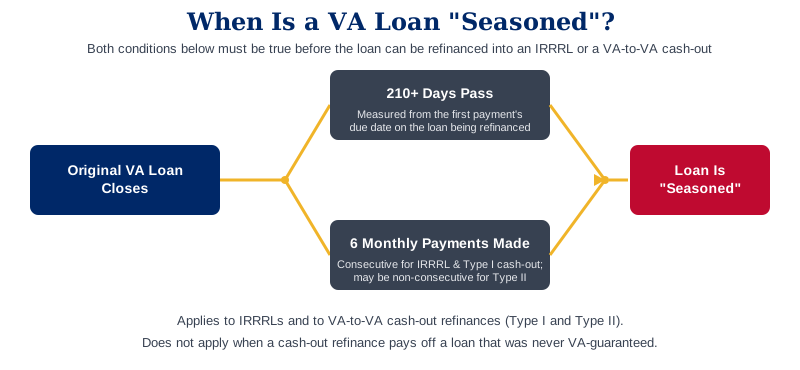
For an IRRRL and for a Type I VA-to-VA cash-out, those six payments must be consecutive. For a Type II VA-to-VA cash-out, they don't have to be. Seasoning doesn't apply at all if you're using a cash-out refinance to pay off a loan that was never VA-guaranteed in the first place.
The 36-Month Recoupment Rule
Separately from seasoning, an IRRRL (and a Type I VA-to-VA cash-out) has to pass a recoupment test. Divide the closing costs and fees rolled into the loan (excluding taxes, escrow, and the VA funding fee) by how much your monthly principal-and-interest payment drops, and that recoupment period can't exceed 36 months. If the refinance doesn't lower your P&I payment at all, say you're only converting an ARM to a fixed rate, you can't be charged any fees or closing costs beyond taxes, escrow, and the funding fee. This rule doesn't apply to Type II cash-out refinances or to a cash-out refinance paying off a non-VA loan.
Not sure what your break-even would look like on a rate-and-term refinance? Run the numbers through the IRRRL Breakeven Calculator, or check whether a given rate drop would even clear VA's rate-reduction floor with the IRRRL Rate Viability Calculator.
Maximum Loan Amount for a Cash-Out Refinance
For a cash-out refinance, the new loan generally can't exceed 100% of the reasonable value of the property, as determined by a VA appraisal. Financing up to $6,000 in energy-efficiency improvements and/or rolling the funding fee into the loan can't push the total over that 100% ceiling. One narrow exception: if you're converting a fixed-rate loan to an ARM as a Type I refinance and financing more than one discount point into the loan, VA caps the loan-to-value at 90% instead.
Keep in mind VA's 100% ceiling is a maximum, not a guarantee. Individual lenders are free to set their own, more conservative equity requirements on top of VA's rule, so what you can actually borrow may be lower depending on the lender. If you're weighing the broader eligibility picture, the VA Loan Limit Estimator is a good starting point.
Why Cash-Out Underwriting Takes Longer
The appraisal and underwriting gap between the two products is intentional. On an IRRRL, VA doesn't require an appraisal or credit underwriting, and lenders can close IRRRLs on an expedited basis. VA carves out only a few exceptions, such as when the loan being refinanced is 30 or more days past due, when the new payment would increase by 20% or more, or when a fixed-to-ARM conversion needs an appraisal to establish the loan-to-value for discount-point limits. Even so, VA is explicit that individual lenders may still choose to order a credit report or appraisal to satisfy their own requirements, and can pass that cost on to you. VA not requiring something isn't the same as your lender not asking for it.
A cash-out refinance gets none of that flexibility: full credit underwriting and a full appraisal are required every time, regardless of Type I or Type II, because VA needs to confirm both your creditworthiness and the home's current value before guaranteeing new money against it.
The Certificate of Eligibility: Required for One, Not the Other
A cash-out refinance goes through your Certificate of Eligibility (COE). VA has to confirm how much entitlement you have available, since a cash-out loan can be made even to a veteran with only partial remaining entitlement, and the maximum loan amount depends on that number.
An IRRRL does not require a COE. VA's lender guidance says so directly, and VA's system returns your funding fee exemption status when the lender requests the VA loan number, so the lender does not need a COE to check it. If you still have the COE from your original loan, VA suggests bringing it to your lender to show the prior use of your entitlement, but it is not a requirement.
Which One Fits Your Situation?
If your only goal is a lower rate, a lower payment, or getting off an ARM, an IRRRL is built to get there with minimal paperwork and, in most cases, no new appraisal. If you need to access home equity, pay off higher-interest debt, or fund a project, a cash-out refinance can do that, but expect full underwriting, a fresh appraisal, and a meaningfully higher funding fee. Neither path is automatically the better one; they solve different problems.
Talk It Through Before You Decide
Every refinance decision comes down to your specific loan, your specific timeline, and how the numbers actually pencil out, not a generic rule of thumb. Gene, a Mortgage Loan Originator, can pull your COE, walk through whether you'd meet VA's Net Tangible Benefit test, and help you figure out which refinance path, if either, actually makes sense for you.
This article is general information, not a commitment to lend or financial advice for your specific situation.
More questions? Read the VA loan Q&A or explore all guides.
Gene Richter, MLO, NMLS #2806488 | PBT Bancorp, NMLS #257781. General information, not a commitment to lend. Not affiliated with or endorsed by the U.S. Department of Veterans Affairs.