Can Someone Else Take Over Your VA Loan? How VA Loan Assumptions Work
If you have a VA loan and want to sell, the buyer does not always need a brand-new mortgage. VA lets a qualified buyer take over your existing loan through an assumption, which VA describes as the transfer of ownership and release of liability of a VA-guaranteed loan. The buyer does not have to be a Veteran. Any qualified purchaser may assume the remaining balance.
The appeal is structural. The buyer takes over the loan you already have, with the terms in the original note and the balance that remains. Those terms, not the market on closing day, govern the loan from then on. VA says Veterans are increasingly using assumptions to sell their home, and in 2024 it introduced a seller form (covered below) so sellers understand what an assumption does to their entitlement.
Two catches keep an assumption from being simple. First, the assumption covers only the loan balance, so if the home is worth more than the seller owes, the buyer has to pay the seller the difference separately. Second, the seller's VA entitlement can stay tied to the old loan.
Who Handles an Assumption
Only the servicer or holder of the current loan can process an assumption. VA says assumptions can only be processed and closed by the holder or servicer with VA automatic authority that is holding or servicing the current loan, and it tells anyone else to refer the borrower or purchaser to that servicer. A new lender or loan officer cannot handle one. For a seller or a buyer, the first call goes to whoever collects the mortgage payment today.
Servicers do not get to opt out. VA Circular 26-23-10 calls assumptions "a fundamental feature of a VA-guaranteed loan," and Circular 26-23-27 lists refusing to accept an assumption package as a failure to follow VA's rules. The servicer still decides whether a given buyer qualifies.
Who Can Assume, and What the Servicer Checks
The servicer reviews a buyer's file much as it would for a VA purchase, using the same underwriting standards. The core conditions:
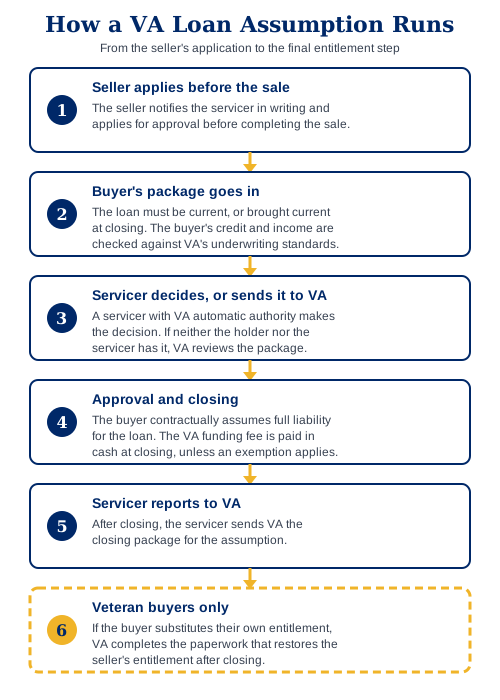
- The loan is current. It must be current, or brought current at or before closing. VA allows cash at closing to do that. It does not allow a loan modification at the time of the assumption, except for a divorce or legal separation, or when the buyer obtains the property by operation of law on a borrower's death.
- The buyer takes on full liability. The buyer must be contractually obligated to purchase the property and assume full liability for the loan.
- The buyer is creditworthy. The statute frames this as qualifying to the same extent as a Veteran eligible for a VA loan.
The package looks like a VA purchase file: a credit report, income verification and a loan analysis. VA's assumption checklist does not list an appraisal, so ask the servicer what it will require.
VA's regulation names two main tests for income adequacy: debt-to-income ratio and residual income. Ordinarily a borrower must meet each one, though missing one does not automatically disqualify. The regulation's reference point for debt-to-income is 41 percent. Treat that as a benchmark, not a hard cap. An approval outside the standards needs a written justification listing compensating factors such as long-term employment, significant liquid assets, or high residual income. Credit history must also show a satisfactory credit risk.
VA also treats servicer-added hurdles as a compliance problem. Circular 26-23-27 lists denying a buyer because of a holder "overlay" (the servicer's own extra criteria) among its examples of servicers failing to follow VA's rules. That does not mean every servicer follows the circular, or that every buyer will qualify.
Occupancy. A Veteran buyer who substitutes entitlement must certify intent to occupy the home, as covered below. For an ordinary assumption, ask the servicer what occupancy documentation it will want.
If the assumption is denied, VA requires the servicer to give its reasons and to tell the seller and the buyer that either one may appeal to VA within 30 calendar days. If the reason was credit, a Fair Credit Reporting Act notice applies.
How the Process Runs
For a loan with a commitment date on or after March 1, 1988, a transfer of ownership needs prior approval from the loan holder or its servicer if either has VA automatic authority. If neither does, VA underwrites the request. The seller must apply for approval before completing the sale, and the law ties release from liability to notifying the holder in writing before the property is disposed of. Loans committed before March 1, 1988 are called freely assumable and follow different rules, though such a loan would ordinarily have reached maturity by now, so the distinction is largely historical.
VA's Deadlines for the Servicer
VA's regulation and assumption circulars set the deadlines below. The clock starts only when the servicer has a complete application package, so send the servicer everything it asks for up front.
| Step | Deadline |
|---|---|
| Servicer with automatic authority tells the seller its decision | 45 days after receiving a complete package (can be extended for documented delays outside the servicer's control) |
| Servicer without automatic authority sends the package to VA | 35 days after receiving a complete package |
| VA decides a package sent for prior approval | 10 business days after receiving a complete package |
| Seller or buyer requests an appeal of a denial | Within 30 calendar days of the denial |
| Servicer sends the appeal package to VA | 7 calendar days |
| VA decides the appeal | 10 business days |
| Servicer closes after VA approves | Should close within 30 calendar days of VA's decision |
These are outer limits, not a forecast of how long an assumption takes from first call to closing. VA's Lenders Handbook lists shorter targets for the first two steps (30 and 21 days). The 45 and 35 days above are the limits in VA's regulation and its servicer-compliance circular.
What an Assumption Can Cost the Buyer
The buyer pays several charges at closing, and the funding fee has to be paid in cash. The figures below are VA's published amounts as of 2026. VA sets them by statute or circular, so they can change.
| Item | What VA says (as of 2026) |
|---|---|
| VA funding fee | 0.5% of the loan balance on the date of transfer. Paid in cash at transfer, and it cannot be financed into the assumed loan. The same rate applies whether or not the buyer is a Veteran. Exemptions apply. |
| Servicer processing fee | Capped at $300. It covers underwriting, processing and closing the assumption. The credit report and other permitted charges are separate. |
| Regional locality variance | $463 in the West group, which includes Colorado. VA permits servicers to charge this in addition to the processing fee. It does not require them to. |
| Other permitted charges | Credit report, recording fees and taxes, other applicable taxes, hazard and flood insurance and assessments, title examination, title insurance and endorsements, and fees approved in advance as local deviations. Passed to the buyer only if incident to the loan. |
| Charges VA does not expressly permit | May not be charged to or paid by the buyer. The seller may pay the real estate commission or brokerage fees. |
| Past-due amounts | Must be brought current at or before closing. VA allows cash at closing to do this. |
The funding fee does not apply to a buyer who falls into one of these groups:
- A Veteran receiving VA compensation for a service-connected disability
- A Veteran who would be entitled to compensation but receives retirement or active-duty pay
- The surviving spouse of a Veteran who died in service or from a service-connected disability (VA's funding fee page ties this to receiving Dependency and Indemnity Compensation)
- A service member with a proposed or memorandum rating before discharge
- An active-duty member who provides evidence of a Purple Heart on or before closing
The exemption applies to the buyer, not the seller.
What Happens to the Seller's Entitlement
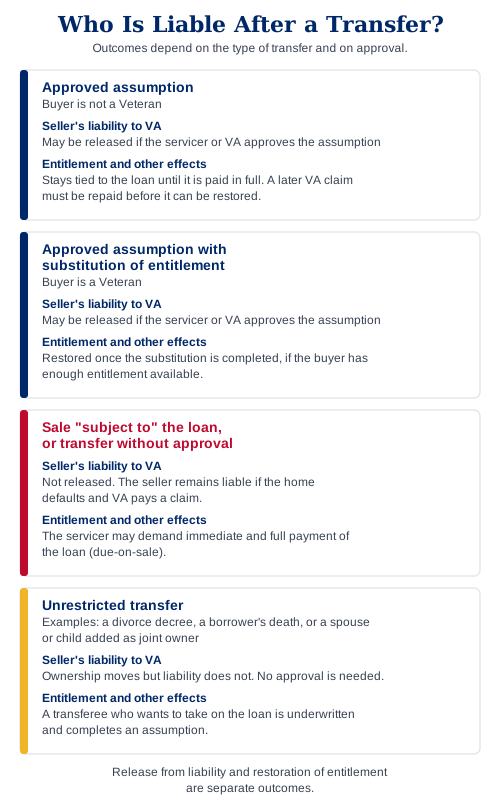
Entitlement is the portion of your VA benefit used to guaranty a loan. An assumption changes who owns the home and who makes the payments, but by itself it does not give the seller that entitlement back. Without a substitution, the original Veteran's entitlement stays tied to the loan until the loan is paid in full, and the seller does not receive a restoration.
Substitution of entitlement
A substitution of entitlement (SOE) addresses this when the buyer is a Veteran. The buyer's entitlement is substituted for the seller's, and the seller's entitlement is restored. The buyer must:
- Be an eligible Veteran
- Intend to occupy the property as their home
- Have enough available entitlement, meaning at least the same amount that was originally used to guaranty the loan being assumed
The buyer provides a Certificate of Eligibility (COE), VA's proof of the buyer's entitlement, and signs VA Form 26-8106, which includes the occupancy certification. For a Veteran without full entitlement, what remains depends on the county loan limit minus the entitlement already in use. The VA Loan Limit Estimator is a place to start on how much entitlement a Veteran buyer may have to work with.
An SOE can involve more than one Veteran splitting their entitlement. It cannot combine a Veteran with a non-Veteran the Veteran is not married to, because that would change the amount of the guaranty. The SOE is set up as part of the assumption, and VA finishes the entitlement paperwork after the servicer closes.
VA Form 26-10291, Assumption Entitlement Acknowledgment, is VA's seller form. It is meant to make sure the selling Veteran understands what the assumption does to their entitlement. VA expects the servicer to hand it over right after an application is received and expects it signed no later than closing.
If the buyer defaults. If no substitution is done and the buyer later defaults, VA may pay a claim. The loss amount must then be repaid in full before the seller's entitlement can be restored. Either the seller or the person who assumed the loan can repay it. VA's Buyer's Guide advises sellers to be highly selective about who assumes their loan, because a default on an assumed loan counts against the original Veteran's entitlement.
Our guide Can You Use Your VA Loan Benefit More Than Once? covers how entitlement comes back after a payoff, or through a one-time restoration if you keep a home.
The two paths compare like this, with SOE short for substitution of entitlement:
| Without SOE | With SOE | |
|---|---|---|
| Buyer must be a Veteran | No. Any qualified purchaser may assume | Yes, an eligible Veteran |
| Buyer paperwork | The standard assumption package | The standard package plus a COE and VA Form 26-8106 |
| Occupancy | Tied to the SOE case. Ask the servicer what it will document | The buyer certifies intent to occupy the home |
| Funding fee | 0.5% of the balance, paid in cash, exemptions apply | Same |
| Credit review | Buyer must be creditworthy under VA's standards | Same |
| Seller's entitlement | Stays tied to the loan until it is paid in full | Restored once the SOE is completed |
| Seller's liability | May be released if the servicer or VA approves | Same |
What Happens to the Seller's Liability
Liability and entitlement are separate questions. Liability is what VA can hold the Veteran responsible for if the loan defaults and VA pays a claim. Amounts VA pays on a claim are a debt owed to the United States by the Veteran.
If the seller notifies the holder in writing before the sale, and the servicer or VA approves the assumption, the seller may be relieved of further liability to VA on the loan, including liability for a loss from a later default by the buyer or any later owner. That release does not restore entitlement, which stays used until the loan is paid off or a substitution is completed.
Without an approved assumption, the seller has much less protection. If the home is sold "subject to" the existing mortgage, or ownership moves without approval, the holder may demand immediate and full payment of the loan. The buyer usually has no liability on the loan in that case, and the seller is still liable if the home later defaults and VA pays a claim.
A sale by installment contract or contract for deed, where title does not pass, is not treated as a disposition under VA's assumption statute and needs no servicer or VA approval. The seller remains liable for repaying the loan. If the contract calls for title to transfer before the loan is paid off, an assumption approval is required.
One narrow path exists after a denial. If VA upholds the denial, the seller may ask within 15 days for special approval. VA may allow the transfer if the seller cannot keep making payments and has made reasonable efforts to find a creditworthy buyer, but the seller is then not released from liability to VA.
The Equity Gap
An assumption carries over the existing loan balance, not the sales price. If the home sells for more than the balance, the difference is the seller's equity, and the assumption does not pay it out. The buyer has to pay the seller that amount separately, such as with cash or a second loan. That difference is the equity gap.
Here is a simple illustration. If a home sells for $400,000 and the loan balance is $300,000, the buyer takes over the $300,000 loan and still owes the seller the $100,000 difference. The numbers are for illustration only. VA's Buyer's Guide says the seller and buyer can negotiate how much of the equity the seller cashes out as part of the sale.
VA's Circular 26-24-17 addresses the gap directly. The buyer may need to obtain another lien to help finance the purchase. VA calls this secondary borrowing and says it is "generally not prohibited by VA," with conditions the servicer must make sure are met:
- The second lien must be junior to the VA loan, for example through a subordination agreement.
- The proceeds may go only to allowable closing costs or amounts due the seller at closing as part of the assumption. The buyer gets no cash back.
- The second loan's monthly payment counts in the buyer's debts when the servicer underwrites the buyer.
- The second loan's interest rate may exceed the rate on the VA loan and may be negotiated.
- If the second loan is not assumable, the servicer should counsel the buyer that it may restrict their ability to sell to another assumer later.
Because that second payment counts in the buyer's debts, run the combined picture through the Home Affordability Calculator before making an offer. A buyer who finds the gap too large can weigh a new loan instead with the VA vs FHA vs Conventional comparison. Gene, a Mortgage Loan Originator (MLO), may be able to help a buyer arrange that second loan, depending on the buyer's qualifications and what the servicer requires.
Divorce, Death, and Family Transfers
Some transfers are "unrestricted." They need no approval from the servicer or VA, cannot trigger acceleration, and are not assumptions. They convey ownership but not liability. VA's list includes:
- A transfer to a relative resulting from the death of a borrower
- A transfer where the borrower's spouse or child becomes a joint owner
- A transfer into a living trust where the borrower remains a beneficiary
- A transfer resulting from a divorce decree, legal separation agreement or incidental property settlement that makes the spouse the sole owner
A person who receives the home this way and wants to be liable for the loan must be underwritten by the servicer and complete a full assumption.
In a divorce where the Veteran keeps the home, the servicer may release the non-Veteran spouse without a full assumption once it receives the decree or separation agreement and a recorded deed, such as a quit claim, to the Veteran. If the ex-spouse keeps the home, the Veteran may seek a release of liability, which needs the ex-spouse to qualify. An ex-spouse who is also a Veteran can substitute entitlement.
After a borrower's death, a successor who wants to be the liable borrower goes through the assumption process. VA's list of exceptions is specific, so a sale to a family member outside the cases above should be treated as an ordinary assumption.
Questions to Ask the Servicer
Ask the servicer of the existing loan:
- What are the processing fee and any locality charge today, and what is the timeline once the package is complete?
- Is my loan funded through a state or local housing program? Those programs can require acceleration if the home is sold to someone who does not qualify for the program, and VA's borrower notice says basic rights may not apply.
- Is the loan current? If it is behind, the past-due amount has to be brought current at or before closing.
- Did I use VA's COVID-19 partial claim? VA Circular 26-23-10 says that assistance must be repaid in full immediately on transfer of ownership.
- Will the buyer need a second loan to pay the seller the difference between the price and the loan balance, and what will the servicer require for it?
- Is a substitution of entitlement possible with this buyer, and what will the servicer document for occupancy?
Get Help Before You List or Make an Offer
A seller can have a mortgage professional review their Certificate of Eligibility and entitlement before listing, to see what an assumption would leave tied up. A buyer can compare assuming a loan with getting a new VA loan, or look at how a second loan could pay the seller's equity. As a mortgage loan originator, Gene can work with a buyer to explore all options and assist with borrowing needs. Financing depends on the buyer qualifying, and he cannot process an assumption or promise an approval or a faster decision, because only the current servicer or holder handles that.
This article is general information, not a commitment to lend or financial advice for your specific situation. VA assumption rules and fees are set by VA regulations and circulars that can change, so confirm current requirements with the servicer.
More questions? Read the VA loan Q&A or explore all guides.
Gene Richter, MLO, NMLS #2806488 | PBT Bancorp, NMLS #257781. General information, not a commitment to lend. Not affiliated with or endorsed by the U.S. Department of Veterans Affairs.